


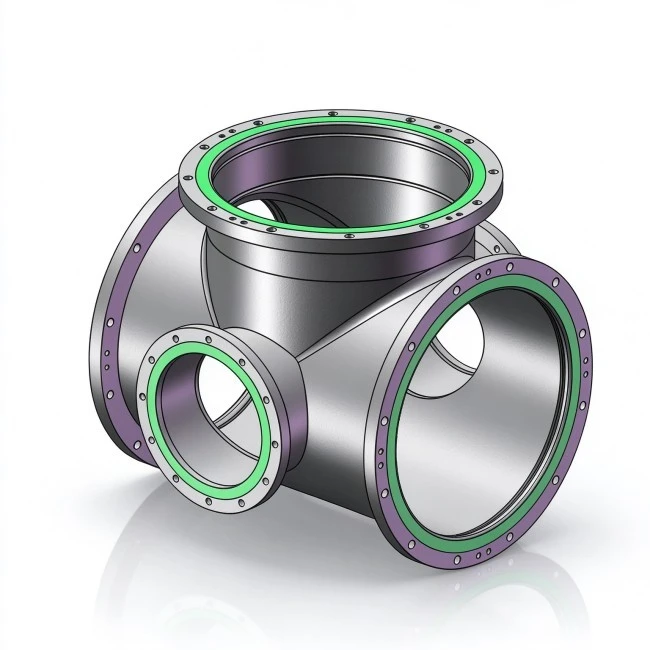
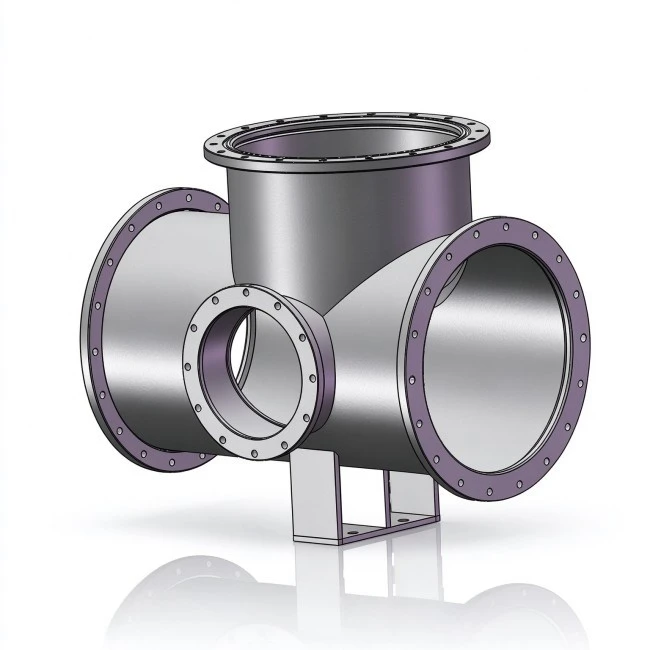
Cangzhou Jianbo Electric Power Equipment Co., Ltd. is one of the most reliable manufacturers and suppliers of 5-way gis cross busbar enclosure in China. With abundant experience, we are committed to providing high quality customized service for global clients. If you're going to buy bulk 5-way gis cross busbar enclosure made in China, welcome to get free sample from our factory.
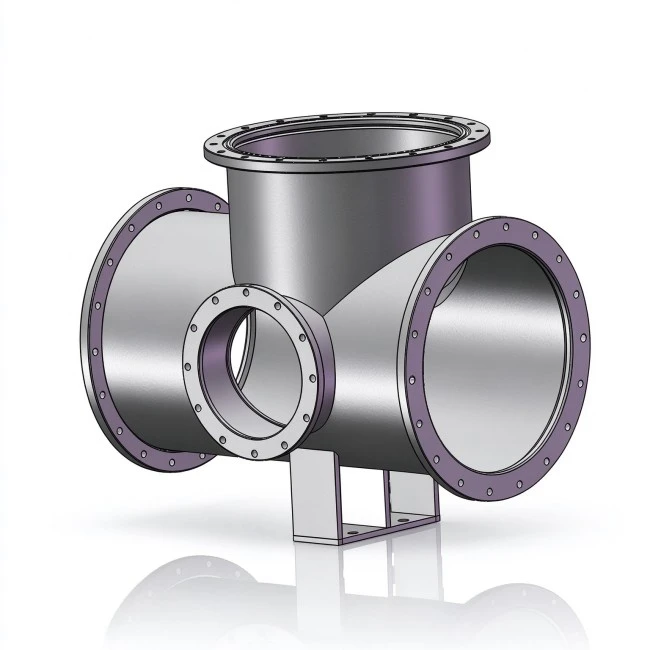
The GIS Cross Busbar Enclosure (5-way) is a dedicated five-port cross junction metal pressure housing designed exclusively for GIS multi-direction busbar convergence and branching. Different from conventional 3-way/4-way busbar tee and cross housings, this 5-way GIS busbar junction tank provides one central main interface plus four lateral branch interfaces, supporting complex busbar layout of main incoming, multi-circuit outgoing and expansion reserved ports in one single compartment.
This GIS five-port cross bus housing adopts integral reinforced cross structure, solving the layout limitation of ordinary multi-way shells that cannot satisfy multi-branch concentrated convergence. Each enclosure is strictly inspected with hydrostatic pressure test, full-flange helium leak scanning, full weld NDT and particle-free internal cleaning, ensuring stable gas tightness and electric field uniformity for long-term GIS junction operation. Widely purchased by GIS integrators, substation EPC contractors and new energy power station equipment suppliers for complex busbar junction modular matching.
|
Product Name |
5-way GIS Cross Busbar Enclosure |
|
Material |
Aluminum Alloy / Low-magnet Carbon Steel |
|
Rated Voltage |
72.5kV / 126kV / 145kV / 252kV (Custom) |
|
Port Structure |
5-way cross junction (1 main + 4 branch customizable direction) |
|
Welding Technology |
Integrated forming + automatic seam welding + stress relief treatment |
|
Factory Standard Test |
Hydrostatic pressure test, full flange helium sniff scan, weld UT/RT NDT, inner particle cleaning |
|
Sealing Performance |
Annual SF6 leakage rate ≤ 0.3% |
|
Surface Treatment |
Sandblasting + anti-aging epoxy coating |
|
Reserved Interface |
Standard GIS flange, SF6 inflation/density monitoring port, grounding terminal |
|
Executive Standard |
IEC 62271-203, GB/T 7674-2020 |
|
Certification |
ISO9001 / ISO14001 / ISO45001 |
Core Product Advantages
① 5-way Integrated Junction, Simplify Complex GIS Layout
Different from 3-way and 4-way common bus enclosures, the 5-way cross structure integrates 5 busbar connecting ports in one unit. It avoids stacking multiple transition housings at bus convergence nodes, effectively reducing overall station equipment quantity, lowering on-site assembly workload and minimizing potential leakage points.
② Reinforced Cross Structure, Anti-deformation Under Multi-port Assembly Force
The cross junction stress concentration area is locally thickened and structurally reinforced. After welding stress relief treatment, the shell maintains stable geometric tolerance under multi-direction bolt fastening force. No flange offset or deformation occurs during multi-port synchronous assembly, ensuring 100% on-site flange matching.


③ Customizable Port Direction & Flange Parameters
All five ports support customized orientation, flange size, bolt circle and sealing groove dimensions. It can match different brand GIS equipment interfaces and reserved expansion requirements, adapting to non-standard complex substation busbar design without extra adapter sections.
④ Uniform Inner Cavity Electric Field, Low Partial Discharge Performance
Inner cross transition area adopts smooth arc transition design without sharp corners or welding burrs. Professional inner cavity purification eliminates floating metal particles, stabilizing electric field distribution at busbar convergence and effectively suppressing partial discharge risks at complex junction nodes.
⑤ Full-port Helium Inspection, Reliable Long-term Air Tightness
Not only full weld inspection, but all five port flange sealing surfaces are implemented targeted helium leak scanning. Multi-direction joint hidden micro-leak points are fully eliminated, ensuring long-term stable SF6 sealing performance for multi-branch busbar nodes.
FAQ
Q1: What core advantages does 5-way cross busbar enclosure have compared with traditional 4-way busbar housing?
The 5-way design adds one reserved expansion port on the basis of four-direction branching. It integrates convergence, branching and reserved expansion functions in one shell, avoiding redundant splicing of multiple transition housings, reducing node leakage points and optimizing overall GIS station layout.
Q2: Can all five ports of this GIS cross busbar enclosure adopt different flange specifications?
Yes. We support full custom of each port's flange size, bolt circle and sealing groove. All non-standard interface parameters need to be confirmed in the drawing stage to ensure perfect on-site assembly.
Q3: Why reinforced structure is necessary for 5-way cross busbar junction shell?
The five-port cross junction bears multi-direction assembly tension and structural stress. Ordinary unstrengthened shells are prone to flange distortion and seal groove dislocation. Local reinforcement and stress relief treatment effectively solves structural deformation risks of multi-way junction nodes.
Q4: What scenario is the 5-way cross busbar enclosure most suitable for?
It is mainly applicable for GIS main busbar central junction nodes requiring multi-circuit outgoing and future expansion reservation. It is the optimal solution for intensive layout of urban underground substations and multi-branch busbar networking of new energy power stations.
Q5: What inspection items are specially increased for 5-way multi-junction enclosure compared with straight and tee housings?
On the basis of conventional tests, we add multi-point geometric tolerance detection of cross stress concentration zone and full five-port flange independent helium leak scanning, ensuring structural stability and air tightness consistency of complex multi-way nodes.
Q6: Is aluminum alloy or low-magnet steel more recommended for 5-way busbar junction shell?
Aluminum alloy is the mainstream choice for busbar junction nodes, with lighter weight, lower eddy current loss and better electric field stability. Low-magnet carbon steel is suitable for projects requiring ultra-high structural rigidity and heavy-load operation.
Hot Tags: 5-way GIS cross busbar enclosure, China 5-way GIS cross busbar enclosure manufacturers, suppliers, factory


